




No products in the cart.
Memory Foam vs Hybrid vs Pocket Sprung: Which One Is Actually You
Affiliate disclosure. Sleeping Express earns a commission when you buy through links on this page. It never changes what you pay, and partner status never buys a recommendation — see how we pick.
There are really only three mattress technologies on sale, and every product is a variation on one of them. Once you know which one suits you, the shortlist gets short fast.
The short answer. Pocket sprung if you sleep hot, are heavier, or want the most durable option. Memory foam if motion isolation and pressure relief matter most and you do not run hot. Hybrid if you want most of both and can afford it — which is why it is the default recommendation for most people.
The three constructions
Pocket sprung
Individual springs, each in its own fabric pocket, topped with comfort layers of foam, wool, cotton or polyester. Springs compress mostly independently, so the surface contours to you and movement does not travel far. Air moves through the spring unit continuously, which is why sprung beds sleep cooler than anything else.
Steel also recovers from compression better than foam does over years, so a well-made pocket-sprung mattress is generally the most durable option — particularly under heavier loads. The weakness is the comfort layers: cheap ones use polyester fibre that compacts within a couple of years, which is how a mattress develops body impressions while the springs are still fine.
Memory foam
Viscoelastic polyurethane. It softens with body heat and returns to shape slowly, which spreads your weight over a larger contact area and reduces peak pressure at the shoulder and hip. It absorbs energy rather than returning it, so motion isolation is the best of the three.
Two real drawbacks. Closed-cell foam blocks airflow, so it sleeps warm — gel infusions and open-cell variants help but do not eliminate it. And the same slow rebound that feels supportive makes turning over take more effort, which some people find restful and others find like wading.
Hybrid
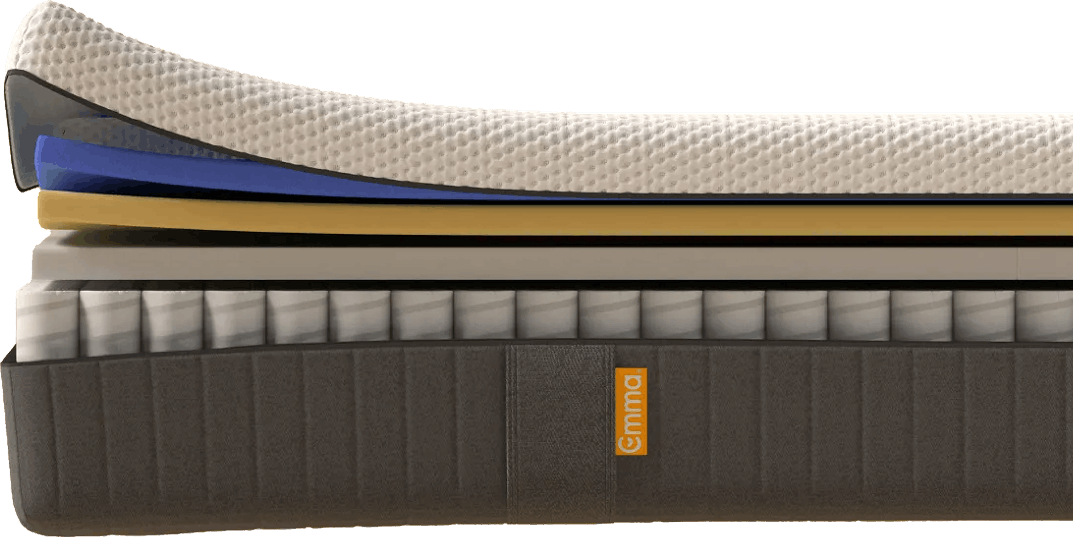
A pocket spring core with a substantial foam or latex comfort layer above it. You get the airflow and durability of springs with the pressure relief and motion isolation of foam. It is genuinely the best compromise for most people, and it is also where most of the marketing money goes, so read the construction rather than the word.
The number that matters is comfort layer depth. A hybrid with 2cm of foam over springs behaves like a sprung mattress. One with 10cm of memory foam over springs behaves — and sleeps — much more like a foam mattress.
Side by side
| Pocket sprung | Memory foam | Hybrid | |
|---|---|---|---|
| Temperature | Coolest | Warmest | Cool to neutral |
| Pressure relief | Moderate | Best | Very good |
| Motion isolation | Good | Best | Very good |
| Ease of turning over | Best | Hardest | Good |
| Durability under weight | Best | Weakest | Very good |
| Edge support | Good | Usually weakest | Good |
| Weight to move | Heavy | Very heavy | Heaviest |
| Typical price | Widest range | Lowest entry point | Highest |
Approved partners relevant to this guide
These are the sleep-related programs currently shown as Joined in our Awin account. Partner status never determines the order of our advice.
Mattresses & pillows
SweetNight
Approved for US shoppers comparing mattresses, pillows, cooling bedding and selected bed frames. Check the exact product trial and return terms.
Canadian bed frames
Relax The Back
Approved Canadian partner for platform bed frames. Confirm dimensions, support layout and delivery terms for the selected model.
Sheets & bedding
Egyptian Linens
Approved US bedding partner. Compare fibre, weave, fitted-sheet depth and care instructions rather than relying on thread count alone.
Choose by your actual problem
- You wake up hot or damp. Pocket sprung, or hybrid with a shallow comfort layer. Avoid all-foam.
- Your shoulder or hip goes numb. Memory foam or a hybrid with a deep comfort layer. This is what foam is genuinely good at.
- Your partner wakes you. Foam is best, high-count pocket sprung is close behind and cooler.
- You are over about 110kg. Pocket sprung or hybrid, 25cm minimum depth. Foam fatigues fastest under load.
- You struggle to change position at night. Pocket sprung. Memory foam will make this worse.
- Your lower back aches in the morning. This is a support problem, not a construction one — get the firmness right first, in any of the three.
Common questions
Is a hybrid always better than a pocket sprung mattress?
No — it is better at pressure relief and worse at price and weight. If you sleep hot and do not have pressure points, a good pocket-sprung mattress is the better buy and usually cheaper.
What about latex?
Latex is the quiet fourth option: breathable like springs, pressure-relieving like foam, extremely durable, and responsive rather than slow. The drawbacks are cost and weight. If the budget stretches, it is worth considering seriously.
Do I need to turn my mattress?
Two-sided mattresses should be turned and rotated seasonally. Most modern one-sided and hybrid mattresses should be rotated head to foot but never flipped. Check the label — flipping a one-sided mattress puts you on the support core.
How long should each type last?
Roughly: pocket sprung 8-10 years, hybrid 7-10, memory foam 6-8. Heavier sleepers should take the lower end of each range.
Is bed-in-a-box as good as a traditional mattress?
Vacuum compression does not damage foam or pocket springs, so the format itself is fine. The question is what is inside. Judge it on density, depth and spring count exactly as you would anything else.
How we pick. We shortlist from retailers we have a verified commercial relationship with, then rank on construction, firmness accuracy, trial length and returns policy — not on commission rate. We are not a medical service; if pain wakes you every night, see a clinician before you buy a mattress.