




No products in the cart.
The Best Mattress for Side Sleepers: Shoulder and Hip Pressure, Solved
Affiliate disclosure. Sleeping Express earns a commission when you buy through links on this page. It never changes what you pay, and partner status never buys a recommendation — see how we pick.
Side sleeping is the most common position and the one most poorly served by mattresses bought on a showroom floor. You are putting most of your body weight through two narrow points — the shoulder and the hip — and a surface that does not let those two sink will keep you turning over all night.
The short answer. Side sleepers need pressure relief at the shoulder and hip with support everywhere else. That means a zoned or pocket-sprung mattress with a genuine comfort layer, usually one firmness step softer than a back sleeper of the same weight would choose.
What goes wrong for side sleepers
Lie on your side on a hard floor and the pain arrives within minutes, at the shoulder and the greater trochanter of the hip. Those are the two places where bone sits close to the surface with very little tissue between. A mattress that does not allow them to sink produces the same effect more slowly: capillary compression, reduced blood flow, and a signal to roll over. You are unlikely to notice this consciously — you notice it as a dead arm, a sore hip, or simply as waking unrefreshed after eight hours in bed.
The opposite failure is more insidious. Too soft, and the hip — the heaviest single point — sinks further than the shoulder and the ribcage. The lumbar spine ends up laterally flexed for hours. That is the classic “new soft mattress, new lower back ache” story.
The test that actually works
Lie on your side in your normal position and have someone look at you from behind. Your spine, from the base of your skull to your tailbone, should be a straight horizontal line. If it dips at the hips, the mattress is too soft. If it arches up at the waist, it is too firm. Do this in the shop, in your own sleepwear position, for at least ten minutes — not the fifteen-second bounce most people give it.
Approved partners relevant to this guide
These are the sleep-related programs currently shown as Joined in our Awin account. Partner status never determines the order of our advice.
Mattresses & pillows
SweetNight
Approved for US shoppers comparing mattresses, pillows, cooling bedding and selected bed frames. Check the exact product trial and return terms.
Canadian bed frames
Relax The Back
Approved Canadian partner for platform bed frames. Confirm dimensions, support layout and delivery terms for the selected model.
Sheets & bedding
Egyptian Linens
Approved US bedding partner. Compare fibre, weave, fitted-sheet depth and care instructions rather than relying on thread count alone.
What to look for on the spec sheet
- Zoned support. Softer springs at the shoulder, firmer at the hips and lumbar. For side sleepers this is the single most useful feature on a spec sheet, and it is genuinely engineered rather than marketing.
- A comfort layer of at least 4-5cm. Anything thinner cannot let a shoulder sink far enough to matter.
- Pocket springs, not open coil. Open-coil units move as one sheet, so the whole area under you compresses together and you get no shoulder relief.
- Edge support if you sleep near the edge. Side sleepers who share a bed often end up on the outer third. Weak edges mean a sloping surface and a rolled pelvis.
- A trial period of 60 nights or more. Side sleeping problems show up over weeks, not minutes. A short trial is close to useless here.
Not sure which firmness is yours?
Compare trial lengths and return terms before you compare specs. For side sleepers, the ability to send it back matters more than any number on the label.
Pillow height matters as much as the mattress
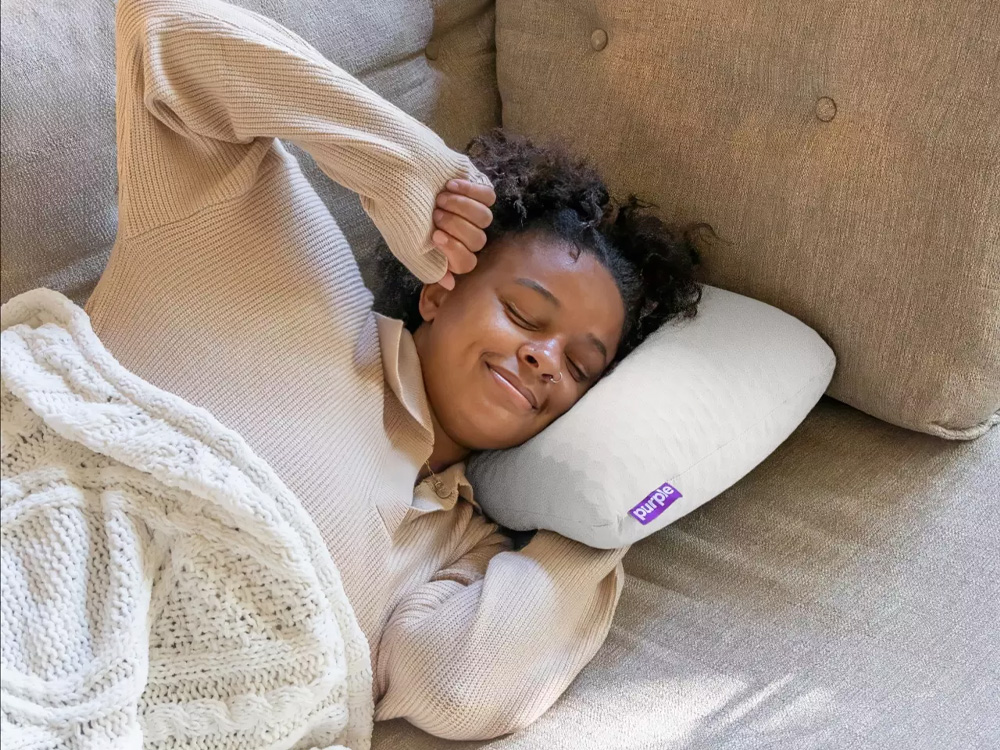
This is the part people skip. On your side, the gap between your ear and the mattress is roughly the width of your shoulder — far more than when you lie on your back. A pillow that suits a back sleeper will crank a side sleeper’s neck upward for eight hours and produce exactly the shoulder and neck pain they blame the mattress for.
Measure it: lie on your side against a wall and check the distance from the outside of your shoulder to the side of your neck. That, roughly, is your pillow loft. Most side sleepers need 10-14cm and are using something closer to 7cm.
Common questions
Is memory foam good for side sleepers?
It relieves pressure very well, which is why it feels wonderful for the first ten minutes. The problems are heat retention and the effort of turning over during the night. A hybrid with a memory or latex comfort layer over pocket springs gives you most of the pressure relief without either drawback.
My arm goes numb every night. Is that the mattress?
Usually yes, and usually a mattress that is too firm at the shoulder. Before you buy anything, try a folded towel under your waist for a few nights — if the numbness eases, your shoulder is not being allowed to sink far enough.
Should side sleepers use a mattress topper?
If your mattress supports you correctly but presses on the shoulder and hip, a topper is the right and cheap fix. If your hips are already sinking too far, a topper will make it worse, not better.
Does the side I sleep on matter?
For most people, no. If you have reflux, left-side sleeping reduces it measurably. If you are pregnant, left-side is generally advised in later pregnancy. Otherwise sleep on whichever side you find comfortable.
How firm is “medium” really?
There is no industry standard, which is the frustrating answer. One brand’s medium is another’s medium-firm. This is precisely why the trial period is the specification that matters most.
How we pick. We shortlist from retailers we have a verified commercial relationship with, then rank on construction, firmness accuracy, trial length and returns policy — not on commission rate. We are not a medical service; if pain wakes you every night, see a clinician before you buy a mattress.